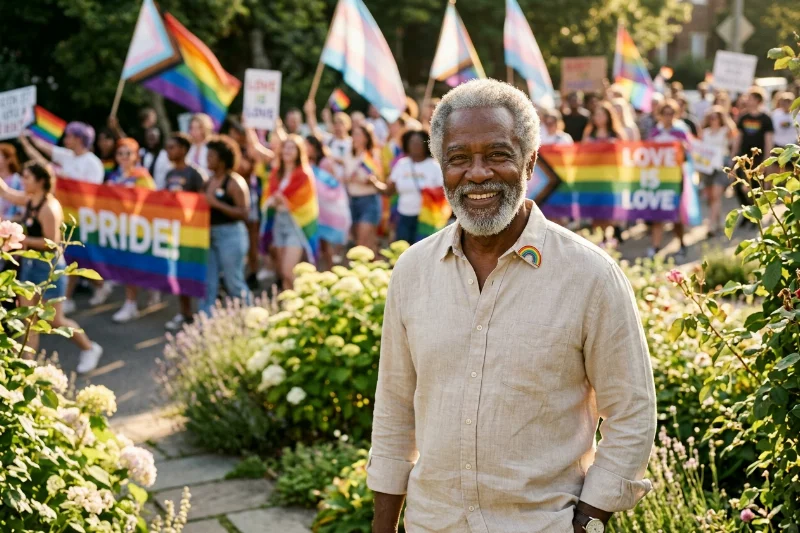
The Sanctuary of Visibility: Why I Openly Celebrate Pride at Sixty
Marcus Thorne
June 5, 2026
As I sit in my study, the morning light filtering through the leaves of a towering oak, I am struck by the weight of the word ‘Pride.’ At sixty years old, having navigated the corridors of academia and the trenches of grassroots activism, I’ve learned that Pride is not merely a parade or a seasonal marketing campaign. For a man of my vintage—a Black man who has loved men in a world that often demanded my invisibility—Pride is an architectural feat of the soul. It is the scaffolding we build to hold ourselves upright when the winds of systemic erasure blow hardest.To understand what Pride means to me, one must first understand the sociology of the closet. In my youth, the closet was not just a metaphor; it was a survival strategy dictated by a society that pathologized our existence. To emerge from that darkness was an act of radical redefinition. Today, when I see the rainbow flags fluttering in the breeze, I don’t just see colors; I see a census of the resilient. I see a public declaration that our lives are worthy of being recorded, analyzed, and celebrated in the light of day.
The Intersection of Race, Sexuality, and Memory
My perspective is inextricably linked to my identity as a Black man. In the sociological tapestry of America, the intersections of race and sexuality create unique patterns of both struggle and strength. For too long, the narrative of Pride was whitewashed, ignoring the Trans women of color who sparked the flames at Stonewall. When I celebrate, I carry the ancestors with me—those who fought the double demons of Jim Crow and homophobia. Open celebration is my way of honoring their unrecorded sacrifices.We often speak of the ‘LGBTQ+ community’ as a monolith, but as an advocate, I recognize it as a vibrant, sometimes fractured, yet necessary coalition. Openly celebrating Pride allows us to confront the internal biases that still linger within our movement. It is an invitation to practice the intersectionality we preach, ensuring that the ‘we’ in our celebrations includes the most marginalized among us. It is about creating a space where my Blackness and my gayness do not have to compete for oxygen.
Breaking the Silence of the Older Generation
There is a peculiar kind of ageism that permeates modern queer culture, a focus on the ‘new’ that often forgets the ‘now’ of its elders. As a man in my sixth decade, my presence at Pride is a testament to survival. During the height of the AIDS crisis, I watched a generation of my peers disappear. To celebrate openly now is to be a living library, a bridge between the trauma of the past and the possibilities of the future. My visibility serves as a reminder that we do, in fact, grow old.When I walk through the streets during June, I am often met with the wide-eyed gaze of younger folks. In my silver hair and upright carriage, they see a future they weren’t always sure was possible. This is the ‘micro’ impact of Pride—the individual connection that reassures a twenty-something that the road ahead, while steep, is paved with the footprints of those who came before. It is a validation of longevity in a world that often treats queer life as a transient phase.
The Sociology of Joy as Resistance
In my academic work, I often discuss ‘the politics of joy.’ For marginalized groups, joy is not a luxury; it is a defensive mechanism. Systemic oppression thrives on the suppression of the spirit. Therefore, when we dance, when we laugh, and when we openly declare our love, we are engaging in a sophisticated form of social protest. We are refusing to be defined by our trauma, choosing instead to be defined by our capacity for connection and delight.Openly celebrating Pride is a challenge to the status quo that would prefer we remain ‘discreet.’ Discretion is often just a polite word for shame. By refusing to hide, we force the world to adjust its lens. We move from being ‘the other’ to being the neighbor, the colleague, the mentor, and the friend. This shift in social dynamics is how we move the needle on policy and systemic change—by humanizing the statistics.
The Power of Community and Collective Healing
Isolation is one of the most potent tools of social control. When we are separated, we are vulnerable. Pride creates a ‘communitas’—a temporary state of equality and togetherness that transcends our daily hierarchies. In this space, the sociologist in me sees the healing of ‘minority stress.’ For one month, the environmental stressors of being a minority are mitigated by the sheer density of our shared presence.This collective healing is vital for our mental health. It allows us to exhale the microaggressions we’ve swallowed throughout the year. As an advocate, I’ve seen how these moments of communal affirmation can literally save lives. It provides the psychological armor necessary to face the remaining eleven months of the year where the world may not be as welcoming.
Why Open Visibility Still Matters
Some might argue that in an era of increasing legal rights, the ‘spectacle’ of Pride is no longer necessary. I strongly disagree. Legal rights are fragile without cultural shifts. We see the rising tide of legislation targeting our trans youth and the persistent violence against Black queer bodies. Visibility is not about ‘showing off’; it is about ‘showing up’ to ensure we are never pushed back into the shadows of history.Furthermore, visibility serves as a beacon for those who cannot yet safely come out. In every small town and every restrictive household, there is someone looking at the images of Pride and finding the courage to persevere. We celebrate openly for them. We are the proof that a full, vibrant, and dignified life is waiting on the other side of the closet door.
Redefining the Narrative of the Black Gay Man
As a Black gay man, I am also fighting against stereotypes within my own racial community and the broader public. Openly celebrating Pride allows me to present a narrative of complexity. I am a man of faith, a man of science, a Black man, and a gay man. These identities do not exist in silos; they inform one another. Pride is where I integrate these parts of myself into a cohesive, public whole.I remember a time when I felt I had to choose which ‘battle’ to fight. Pride taught me that my liberation is tied to the liberation of all my identities. When I stand in the sun, I am advocating for a world where a Black boy can grow up to be a sociologist and a husband without fear. That is the macro-shift I work toward every day.
The Evolution of a Movement
Our movement has evolved from a riot to a revolution, and now to a complex social phenomenon. While I critique the commercialization of Pride, I also recognize it as a sign of our growing influence. However, we must ensure that the heart of Pride remains rooted in advocacy. We celebrate to remember that the work is not yet finished. We celebrate to recharge our spirits for the advocacy that lies ahead.As a lifestyle expert, I often tell my clients that the most ‘stylish’ thing you can wear is your truth. Authenticity is the ultimate luxury. Openly celebrating Pride is the ultimate expression of that authenticity. It is a commitment to living a life that is honest, even when it is difficult. It is the practice of radical self-love in a world that often forgets how to love.
A Call to Intergenerational Dialogue
I urge my younger peers to reach out to the elders this June. Ask us about the bars that no longer exist, the friends we lost, and the victories we hard-won. And I urge my fellow elders to listen to the youth—to their new language, their evolving identities, and their fierce passion. Pride should be a classroom where we learn from one another.This dialogue is how we sustain the movement. It is how we ensure that the lessons of the past are not lost and that the innovations of the present are grounded in history. When we celebrate together, we create a continuum of resilience that cannot be easily broken by political whims or social backlash.
Conclusion: The Enduring Legacy of Pride
So, what does Pride mean to me? It means that at sixty, I am more myself than I have ever been. It means that my Blackness and my queerness are not burdens to be carried, but gifts to be shared. It means that open celebration is a sacred duty—a way to reclaim the space that was once denied to us and to hold that space open for those yet to come.I will continue to celebrate, openly and unapologetically, for as long as I have breath. Not because the struggle is over, but because our joy is the most potent evidence that we are winning. To everyone reading this: find your pride, build your sanctuary, and never let the world dim your light. We are here, we have always been here, and we are magnificent.