
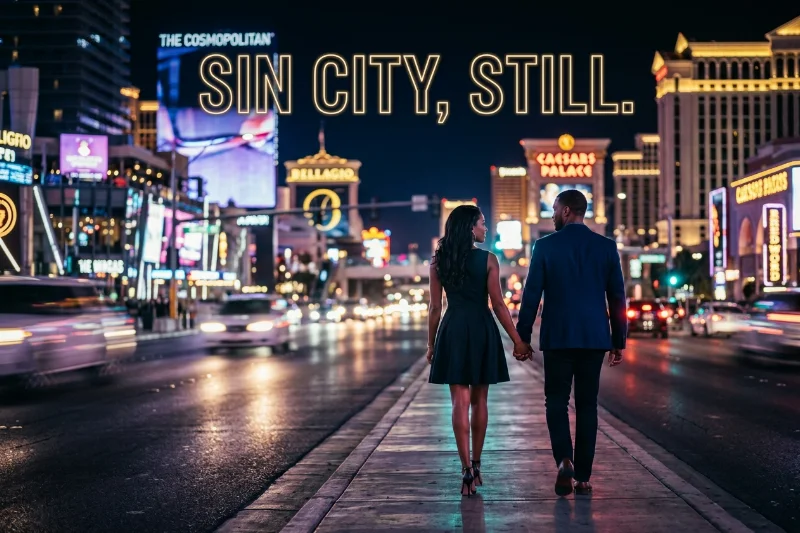
Las Vegas has long occupied a singular space in the collective human psyche, a neon-lit oasis where the rigid structures of daily life are invited to dissolve. As a sociologist and sex educator, I view the city not merely as a tourist destination, but as a living laboratory of human desire and agency. The moniker “Sin City” persists because it serves as a designated container for activities that remain marginalized in the broader cultural landscape, yet Vegas provides a unique intersection where gambling, cannabis, and sexual exploration are not only tolerated but celebrated.
When we look at the evolution of Las Vegas, we see a fascinating shift from back-alley illicit activities to a highly regulated, yet unapologetic, playground. This transition is crucial for our community because it provides a framework for safety and consent that was often missing in the past. We are no longer hiding in the shadows; we are navigating a landscape where our choices—whether they involve the high-stakes risk of the craps table or the intimate exploration of a lifestyle club—are framed by personal autonomy.
The Green Revolution: Cannabis and Social Connection
The legalization of recreational cannabis in Nevada has fundamentally altered the sensory and social fabric of the city. For many in the non-monogamous community, cannabis serves as a powerful tool for social lubrication, helping to lower the defensive barriers that often hinder authentic connection. It allows us to step out of our hyper-vigilant professional personas and into a more present, embodied state of being.
However, the integration of weed into the Sin City experience is about more than just relaxation. It represents a broader movement toward de-stigmatization. When we see upscale dispensaries operating with the same clinical precision as a high-end apothecary, it challenges the antiquated “reefer madness” narratives. This mirrors the work we do in the sexual wellness space: stripping away the shame and replacing it with education, quality control, and responsible consumption.
Risk and Reward: The Psychology of the Gamble
Gambling remains the bedrock of the Las Vegas identity, tapping into a fundamental human drive for risk-taking. From a psychological perspective, the thrill of the bet is not entirely dissimilar to the rush of entering a play party for the first time. Both involve a calculated step into the unknown and a willingness to engage with the possibility of both loss and exhilarating gain. We must recognize that risk is an inherent part of the human experience.
In the lifestyle, we often talk about “emotional stakes.” Just as a gambler must manage their bankroll, we must manage our emotional labor and boundaries. The environment of the casino, with its lack of clocks and constant stimulation, creates a liminal space where the usual rules of time and social expectation are suspended. This suspension is what allows for the profound personal breakthroughs we often witness when couples step outside their comfort zones.
The Heart of the Lifestyle: Swinging in the Desert
Sexual exploration is the true pulse of Sin City, though it is often the most misunderstood. Las Vegas is home to some of the most established and sophisticated swinging clubs in the world. These spaces are not the chaotic environments depicted in media; rather, they are communities built on a foundation of radical consent and mutual respect. For the uninitiated, these venues offer a safe harbor to explore ethical non-monogamy under the guidance of experienced hosts.
When we enter these spaces, we are participating in a tradition of sexual liberation that dates back decades. Vegas provides a high density of like-minded individuals, making it an ideal location for those looking to expand their horizons. The city’s infrastructure supports the lifestyle through discreet resorts, themed events, and a culture that generally adheres to the principle of “mind your own business,” provided everything is consensual.
Navigating Boundaries in a High-Stimulus Environment
With the abundance of gambling, weed, and sexual opportunities, the importance of boundaries cannot be overstated. In my work with couples, I emphasize that the sensory overload of Las Vegas requires a heightened level of communication. We must check in with our partners more frequently here than we might at home. The external stimuli are designed to be distracting, which means our internal compass must be finely tuned.
Consent is not a one-time agreement but an ongoing dialogue. Whether you are negotiating a three-way interaction or simply deciding how much to spend at the blackjack table, the principles of ethical exploration remain the same. We must honor our “no” as much as our “yes,” ensuring that the “sin” in Sin City remains a playful indulgence rather than a source of regret or harm.
Dismantling Cultural Taboos for Asian Communities
As a Taiwanese-American woman, I am acutely aware of how the “Sin City” narrative can be particularly fraught for those of us from cultures that prioritize modesty and discretion. For many in the Asian diaspora, the overt displays of sexuality and indulgence in Vegas can feel like a direct confrontation with traditional values. However, I believe there is profound healing in reclaiming these experiences through a lens of empowerment.
By openly discussing our participation in these “sinful” activities, we break the cycle of shame that has historically silenced us. We prove that one can be a person of integrity, professional success, and cultural pride while also enjoying the visceral pleasures that Las Vegas offers. We are redefining what it means to be “virtuous” by centering honesty and consensual joy over performative purity.
The Intersectionality of Modern Sin
The modern Sin City is an intersectional space. We see people of all backgrounds, genders, and orientations coming together to seek something that the conventional world often denies them: the freedom to be multi-faceted. You can be a cannabis connoisseur, a dedicated spouse in an open marriage, and a strategic poker player all at once. Vegas is one of the few places where these identities don’t have to be compartmentalized.
This intersectionality is where the real magic happens. When we remove the barriers between our different desires, we find a more holistic sense of self. The “sin” is not the act itself, but the societal judgment placed upon it. By embracing the full spectrum of our humanity—the gambling, the weed, and the sex—we are actually practicing a form of radical self-acceptance.
Conclusion: Embracing Your Own Sin City
Ultimately, Las Vegas remains Sin City because it dares to acknowledge the parts of us that we are told to hide. As we navigate its glittering streets, let us do so with intention and care for one another. Whether you are there for the tables, the dispensaries, or the lifestyle clubs, remember that you are the architect of your own experience. The city provides the tools, but you provide the soul.
We invite you to view your next trip to the desert not as an escape from reality, but as a deeper dive into your own truth. By engaging with these taboos openly and ethically, we continue to pave the way for a more liberated, sex-positive world. In the end, the only true sin is living a life that isn’t authentically yours.