
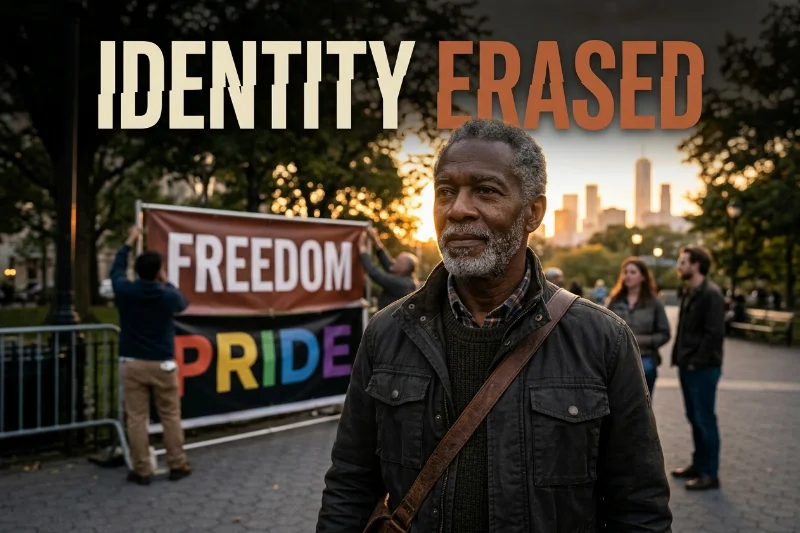
In the sweltering heat of New York City in the late 1980s, I remember the air feeling thick not just with humidity, but with a hard-won sense of arrival. As a young Black gay man navigating a world that often seemed determined to ignore my existence, the word ‘Pride’ was more than a label; it was a lifeline, a radical reclamation of space in a society that preferred us in the shadows. Today, at sixty, I find myself watching with a heavy heart as that hard-earned visibility is being systematically dismantled in statehouses across the country, where the very name of our celebration is being scrubbed from the public square.
We are witnessing a calculated effort in several conservative states to rebrand Pride Month into something sanitized, detached, and ultimately, exclusionary. From Florida to Texas, we see government entities stripping the ‘LGBTQ+’ descriptor from June events, replacing it with broader, more ‘patriotic’ themes like ‘Freedom Month’ or ‘Celebrate America.’ On the surface, these terms appear inclusive, but as a sociologist, I recognize this for what it truly is: a semantic siege designed to erase the specific histories and struggles of queer people from the collective American consciousness.
The Sociological Erasure of Identity
To rename a movement is to attempt to control its narrative and, by extension, the people who belong to it. In my decades of studying behavioral trends, I have observed that when those in power shift the language used to describe marginalized groups, they are usually attempting to diminish the group’s political and social capital. By removing the specific ‘Pride’ branding, state officials are effectively telling the LGBTQ+ community that their identity is too provocative for the public eye, reinforcing the archaic notion that our lives should be a private matter rather than a public reality.
This rebranding isn’t merely a bureaucratic change; it is a profound sociological ‘othering’ that signals whose stories are deemed worthy of state recognition. When we lose the language of Pride, we lose the explicit acknowledgment of the Stonewall uprising, the AIDS crisis, and the ongoing fight for marriage and housing equality. It creates a vacuum where our specific triumphs and tragedies are replaced by a generic, state-approved patriotism that conveniently ignores the systemic barriers many of us still face every single day.
The Intersection of Race and Queer Erasure
As a Black man who has spent my life at the intersections of multiple marginalized identities, I know all too well that when a majority culture calls for ‘neutrality’ or ‘unity,’ it often comes at the expense of those who are already the most vulnerable. For Black and Brown queer individuals, Pride has always been a space where we could begin to reconcile the complexities of our existence. To see it rebranded under the guise of generic ‘freedom’ feels like a double erasure, ignoring the fact that for many of us, the American definition of freedom has historically been a moving goalpost.
This legislative shift creates a chilling effect that extends far beyond the name of a parade or a government building’s lighting scheme. It tells the young Black trans girl in a rural conservative district that even the one month dedicated to her visibility is too much for her neighbors to bear. It validates the prejudices of those who wish to see us gone and compounds the psychological weight of living in a society that is actively trying to un-name you. This is the ‘micro-to-macro’ reality: a small change in a city council agenda translates to a massive loss of safety and belonging on the ground.
Furthermore, the psychological impact of this erasure cannot be overstated. When a state officially declares that ‘Pride’ is no longer a sanctioned term, it implicitly tells its citizens that the people represented by that word are no longer a sanctioned part of the community. This fuels an environment where homophobia and transphobia can flourish under the protection of state-sponsored ‘neutrality,’ making it harder for advocacy groups to secure funding and for individuals to find the communal support they need to survive.
The False Narrative of Neutrality
The proponents of these rebranding efforts often argue that they are simply trying to make public events ‘neutral’ or ‘family-friendly.’ This is a classic rhetorical tactic used to frame LGBTQ+ identities as inherently non-neutral or adult-oriented. By suggesting that ‘Pride’ is somehow inappropriate for families, they are reinforcing the very stigmas that the movement was created to dismantle. In my work as a lifestyle expert, I have seen how this narrative erodes the fabric of diverse communities, creating artificial divides where there should be empathy and understanding.
The ‘neutrality’ they seek is an illusion that serves the status quo. There is nothing neutral about removing a rainbow flag from a public building while keeping other cultural markers intact. It is a deliberate choice to prioritize the comfort of a prejudiced majority over the dignity of a marginalized minority. It is the exercise of cultural hegemony, using the machinery of the state to dictate which identities are ‘standard’ and which are ‘deviant,’ a dynamic that I have spent my entire career challenging.
We must also look at the timing of these moves. This rebranding isn’t happening in a vacuum; it is coinciding with a record-breaking number of anti-LGBTQ+ bills being introduced in state legislatures across the country. The semantic shift is the soft-power counterpart to the hard-power of legislative bans on gender-affirming care and drag performances. It is part of a holistic strategy to push the LGBTQ+ community back into the closet by making the public sphere as inhospitable as possible.
Resilience Beyond the Rebrand
However, if my sixty years on this earth have taught me anything, it is that our community is defined by an extraordinary, stubborn resilience. We have thrived in the shadows before, and while we should never be forced back into them, the strength we built there remains. The states may change the names of the festivals and the colors of the lights, but they cannot strip the Pride from our hearts. Our joy has never been contingent on state approval; it is a grassroots fire that we fuel with our own shared experiences and mutual aid.
The power of community is found in the mentorship between elders like myself and the vibrant, unapologetic youth who are coming up behind us. It is found in the safe houses, the community centers, and the chosen families that exist regardless of what a governor signs into law. We must continue to use our voices—whether through public speaking, academic research, or simple neighborly conversation—to remind the world that we are here, we have always been here, and we will not be rebranded out of existence.
As we move forward, it is vital that we maintain an intersectional focus, ensuring that the most marginalized among us—our trans siblings, our queer people of color, our elders—are not left behind as we navigate this new landscape of erasure. We must be honest about the realities of racism and homophobia while remaining steadfast in our commitment to empathy and inclusion. The narrative is being challenged, yes, but we are the ones who ultimately hold the pen when it comes to our own lives.
In conclusion, let us recognize these rebranding efforts for the desperate gasps of a fading prejudice that they are. While the semantic siege may be real, so is our resolve. We will continue to celebrate our history, our identities, and our love, regardless of the labels the state tries to impose. We are the architects of a more inclusive world, and as long as we stand together, no amount of legislative rebranding can ever truly dim our light or silence our song.