
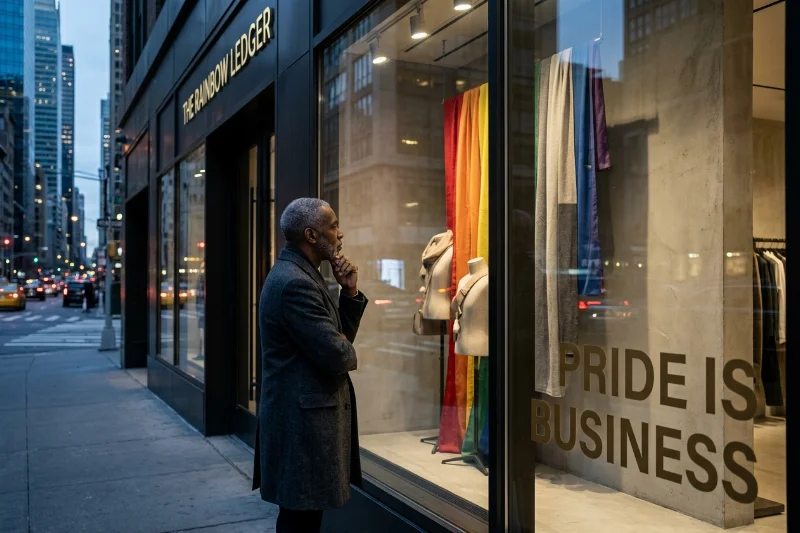
As I walk down Fifth Avenue during the first week of June, I am often struck by the sheer velocity of the chromatic transformation. Shop windows that were, just days prior, defined by the muted neutrals of a high-summer collection are suddenly awash in the spectrum of the Gilbert Baker flag. For a man of my vintage—who remembers when being visible was a revolutionary and often dangerous act—there is a visceral, complicated reaction to seeing a multibillion-dollar fashion house drape itself in the symbols of our struggle. It feels like a validation, yet my sociological training reminds me that in the cathedral of capitalism, every gesture has a price tag.
We must begin by acknowledging a fundamental truth: corporations are not sentient beings capable of empathy; they are legal structures designed to maximize shareholder value. When a fashion brand changes its social media avatar to a rainbow, it is rarely the result of a sudden moral epiphany among the board of directors. Instead, it is the result of rigorous data analytics, trend forecasting, and risk assessment. As a sociologist, I see this not as an indictment of the brands themselves, but as an indicator of where the cultural needle has moved. Our identity is no longer seen as a liability to be hidden, but as a demographic to be captured.
In the late 1980s and early 1990s, the “Pink Dollar” was a whispered secret in marketing departments—a niche market that was lucrative but politically radioactive. Today, the fashion industry views the LGBTQ+ community, and more importantly, our allies, as a critical pillar of their growth strategy. The support we see today is a lagging indicator of social acceptance. Brands are not leading the charge; they are following the trail blazed by decades of grassroots activism, arriving only after the terrain has been made safe for their profit margins.
The Architecture of the Corporate Rainbow
The decision to launch a “Pride Collection” is a year-long logistical undertaking involving supply chains, marketing spends, and retail allocations. When a brand decides to participate, they have calculated that the potential revenue from the queer community and socially conscious Gen Z consumers far outweighs the risk of a conservative boycott. This is the cold calculus of the runway. In the boardrooms I have studied, the rainbow is treated with the same seasonal logic as floral prints for spring or plaid for autumn.
This business-first approach often results in what we call “performative allyship.” It is a shallow engagement where the symbols of the movement are detached from its political and material goals. For a Black gay man like myself, this performativity is particularly glaring when the brand’s internal culture does not reflect its outward-facing marketing. If a company sells shirts printed with “Love is Love” but has no Black or queer individuals in executive leadership, the message rings hollow. It is a costume of inclusion, worn for thirty days and then discarded in the July clearance bin.
Furthermore, the data suggests that brands are increasingly pivoting toward “safe” queer aesthetics. They favor images of young, conventionally attractive, and often white cisgender couples. This sanitized version of Pride is more palatable to a global audience, but it effectively erases the very people who started the movement. The sociology of fashion is the sociology of visibility, and when brands choose who represents “Pride,” they are making a business decision about who is marketable and who is still considered too “fringe” for the mainstream consumer.
Risk Management and the Bottom Line
We must also look at how these brands behave when the political climate shifts. In recent years, we have seen several major retailers retreat from their Pride commitments at the first sign of organized opposition. This retreat is the clearest evidence that their support was never a core value, but a tactical maneuver. When the cost of allyship exceeds the projected profit, the rainbow flags are lowered with alarming speed. For the business, it is a simple pivot; for our community, it is a betrayal of the trust they sought to monetize.
True allyship involves the willingness to absorb risk. It involves standing firm when the winds of public opinion are unfavorable. However, in the fast-fashion and luxury sectors alike, risk is anathema. Therefore, the “support” we receive is often conditional and temporary. It is a seasonal lease on our identity, provided the rent—our consumer loyalty—is paid on time and without controversy.
The Erasure of Intersectionality in Marketing
As a sociologist who focuses on intersectionality, I am particularly troubled by how corporate Pride often flattens our diverse experiences into a monolithic, consumer-friendly blob. The history of Pride is rooted in the resistance of Black and Brown trans women, many of whom were living in poverty and facing state-sanctioned violence. When a luxury brand sells a $500 Pride hoodie, they are often commodifying a struggle that their own economic practices may actually exacerbate through gentrification or exploitative labor.
There is a profound irony in seeing a brand use the imagery of Stonewall while simultaneously donating to political candidates who champion legislation that targets queer and trans youth. This cognitive dissonance is a hallmark of corporate strategy. They are playing both sides of the ledger, seeking our culture for their brand equity while supporting systems that keep us marginalized. It is a micro-transaction of empathy used to mask a macro-system of inequality.
In my decades of advocacy, I have learned that visibility without power is merely a trap. Fashion brands offer us visibility—they put our colors on the world’s most famous streets. But visibility does not pay for healthcare, it does not stop workplace discrimination, and it does not protect the most vulnerable members of our community from violence. If the business decision does not include a redirection of resources to those on the front lines, it is nothing more than a colorful distraction.
The Myth of the Pink Dollar
The term “Pink Dollar” itself suggests a kind of economic unity that doesn’t truly exist. The queer community is as economically stratified as any other. By targeting the affluent queer consumer, fashion brands reinforce a hierarchy within our community where those with the most disposable income are granted the most visibility. This excludes the elders, the trans youth in the foster system, and the queer people of color who are disproportionately affected by economic instability.
When we allow brands to define what Pride looks like, we allow them to set the parameters of our worth. We become a target market instead of a movement. This shift from movement to market is one of the most significant sociological changes in the last half-century of LGBTQ+ history. It represents an assimilation into the very consumerist structures that many of our early activists sought to challenge.
Moving Beyond the Shopping Cart
So, how do we engage with this reality? We must be critical consumers. We must look past the rainbow-striped window displays and ask the hard questions: Where are these clothes made? Who sits on your board? What percentage of the proceeds actually goes to grassroots organizations? If a brand cannot answer these questions with transparency, then their Pride collection is simply a tax on our identity. We must demand that if they want our business, they must also support our lives.
I encourage you to look for the quiet work. The brands that support queer artists year-round, the ones that have inclusive healthcare policies for their trans employees, and the ones that use their platform to speak out when it isn’t June. These are the decisions that move beyond the quarterly earnings report. In our search for community and belonging, we must be careful not to mistake a transaction for a connection. We are more than a demographic; we are a vibrant, resilient, and diverse people with a history that cannot be captured in a polyester blend.
Ultimately, the fact that brands feel the need to court us is a testament to our collective power. We have forced the world to see us. But as we navigate this new landscape of hyper-visibility, let us do so with our eyes wide open. We must remember that while a brand’s support of Pride is a business decision, our response to it can be a political one. We have the power to demand more than just a rainbow—we can demand justice, equity, and a world where our value isn’t measured by what we buy, but by who we are.